小王子第10章·国王的命令
本章读“国王的命令”。先听一遍,再用英文原文核对没有听清的一句话;中文译文可在篇末按需展开。
英文原文#
He found himself in the neighborhood of the asteroids 325, 326, 327, 328, 329, and 330. He began, therefore, by visiting them, in order to add to his knowledge.
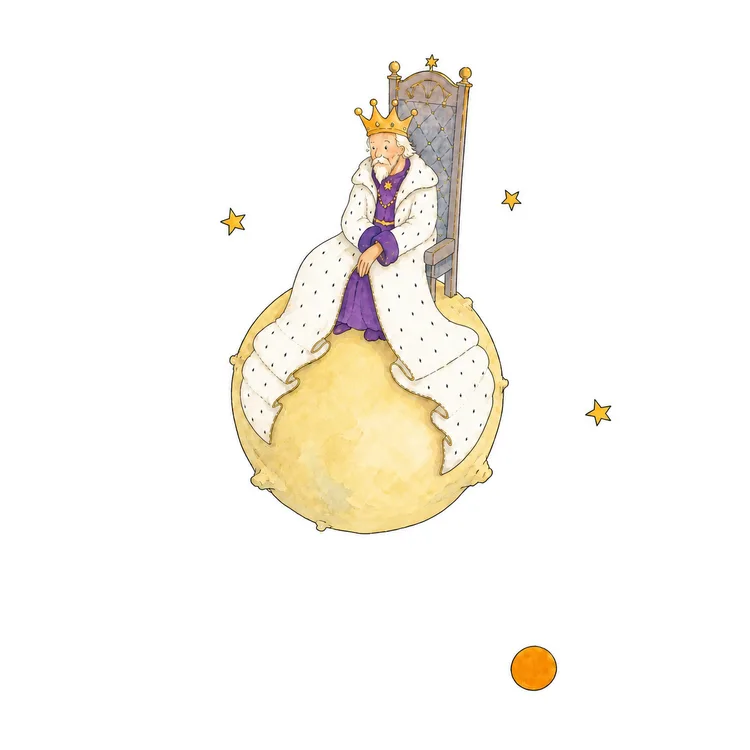
The first of them was inhabited by a king. Clad in royal purple and ermine, he was seated upon a throne which was at the same time both simple and majestic.
“Ah! Here is a subject,” exclaimed the king, when he saw the little prince coming.
And the little prince asked himself:
“How could he recognize me when he had never seen me before?”
He did not know how the world is simplified for kings. To them, all men are subjects.
“Approach, so that I may see you better,” said the king, who felt consumingly proud of being at last a king over somebody.
The little prince looked everywhere to find a place to sit down; but the entire planet was crammed and obstructed by the king’s magnificent ermine robe. So he remained standing upright, and, since he was tired, he yawned.
“It is contrary to etiquette to yawn in the presence of a king,” the monarch said to him. “I forbid you to do so.”
“I can’t help it. I can’t stop myself,” replied the little prince, thoroughly embarrassed. “I have come on a long journey, and I have had no sleep ...”
“Ah, then,” the king said. “I order you to yawn. It is years since I have seen anyone yawning. Yawns, to me, are objects of curiosity. Come, now! Yawn again! It is an order.”
“That frightens me ... I cannot, any more ...” murmured the little prince, now completely abashed.
“Hum! Hum!” replied the king. “Then I—I order you sometimes to yawn and sometimes to—”
He sputtered a little, and seemed vexed.
For what the king fundamentally insisted upon was that his authority should be respected. He tolerated no disobedience. He was an absolute monarch. But, because he was a very good man, he made his orders reasonable.
“If I ordered a general,” he would say, by way of example, “if I ordered a general to change himself into a sea bird, and if the general did not obey me, that would not be the fault of the general. It would be my fault.”
“May I sit down?” came now a timid inquiry from the little prince.
“I order you to do so,” the king answered him, and majestically gathered in a fold of his ermine mantle.
But the little prince was wondering ... The planet was tiny. Over what could this king really rule?
“Sire,” he said to him, “I beg that you will excuse my asking you a question—”
“I order you to ask me a question,” the king hastened to assure him.
“Sire—over what do you rule?”
“Over everything,” said the king, with magnificent simplicity.
“Over everything?”
The king made a gesture, which took in his planet, the other planets, and all the stars.
“Over all that?” asked the little prince.
“Over all that,” the king answered.
For his rule was not only absolute: it was also universal.
“And the stars obey you?”
“Certainly they do,” the king said. “They obey instantly. I do not permit insubordination.”
Such power was a thing for the little prince to marvel at. If he had been master of such complete authority, he would have been able to watch the sunset, not forty-four times in one day, but seventy-two, or even a hundred, or even two hundred times, without ever having to move his chair. And because he felt a bit sad as he remembered his little planet which he had forsaken, he plucked up his courage to ask the king a favor:
“I should like to see a sunset ... Do me that kindness ... Order the sun to set ...”
“If I ordered a general to fly from one flower to another like a butterfly, or to write a tragic drama, or to change himself into a sea bird, and if the general did not carry out the order that he had received, which one of us would be in the wrong?” the king demanded. “The general, or myself?”
“You,” said the little prince firmly.
“Exactly. One must require from each one the duty which each one can perform,” the king went on. “Accepted authority rests first of all on reason. If you ordered your people to go and throw themselves into the sea, they would rise up in revolution. I have the right to require obedience because my orders are reasonable.”
“Then my sunset?” the little prince reminded him: for he never forgot a question once he had asked it.
“You shall have your sunset. I shall command it. But, according to my science of government, I shall wait until conditions are favorable.”
“When will that be?” inquired the little prince.
“Hum! Hum!” replied the king; and before saying anything else he consulted a bulky almanac. “Hum! Hum! That will be about—about—that will be this evening about twenty minutes to eight. And you will see how well I am obeyed!”
The little prince yawned. He was regretting his lost sunset. And then, too, he was already beginning to be a little bored.
“I have nothing more to do here,” he said to the king. “So I shall set out on my way again.”
“Do not go,” said the king, who was very proud of having a subject. “Do not go. I will make you a Minister!”
“Minister of what?”
“Minister of—of Justice!”
“But there is nobody here to judge!”
“We do not know that,” the king said to him. “I have not yet made a complete tour of my kingdom. I am very old. There is no room here for a carriage. And it tires me to walk.”
“Oh, but I have looked already!” said the little prince, turning around to give one more glance to the other side of the planet. On that side, as on this, there was nobody at all ...
“Then you shall judge yourself,” the king answered. “that is the most difficult thing of all. It is much more difficult to judge oneself than to judge others. If you succeed in judging yourself rightly, then you are indeed a man of true wisdom.”
“Yes,” said the little prince, “but I can judge myself anywhere. I do not need to live on this planet.”
“Hum! Hum!” said the king. “I have good reason to believe that somewhere on my planet there is an old rat. I hear him at night. You can judge this old rat. From time to time you will condemn him to death. Thus his life will depend on your justice. But you will pardon him on each occasion; for he must be treated thriftily. He is the only one we have.”
“I,” replied the little prince, “do not like to condemn anyone to death. And now I think I will go on my way.”
“No,” said the king.
But the little prince, having now completed his preparations for departure, had no wish to grieve the old monarch.
“If Your Majesty wishes to be promptly obeyed,” he said, “he should be able to give me a reasonable order. He should be able, for example, to order me to be gone by the end of one minute. It seems to me that conditions are favorable ...”
As the king made no answer, the little prince hesitated a moment. Then, with a sigh, he took his leave.
“I make you my Ambassador,” the king called out, hastily.
He had a magnificent air of authority.
“The grown-ups are very strange,” the little prince said to himself, as he continued on his journey.
中文对照#
展开本章中文译文
他来到了325、326、327、328、329和330号小行星附近。为了增长见识,他决定先去拜访这些星球。
第一颗星球上住着一位国王。他穿着紫红色王袍,披着白鼬皮披风,坐在一张既朴素又威严的宝座上。
“啊!来了一个臣民!”国王看见小王子走来,便叫道。
小王子心里想:
“他从没见过我,怎么会认出我呢?”
他不知道,对国王来说,世界有多么简单。在他们眼里,所有人都是臣民。
“走近些,让我看清楚你。”国王说。他终于有了一个可以统治的人,感到无比自豪。
小王子四处看了看,想找个地方坐下,可国王华丽的白鼬皮长袍把整颗星球都占满了。他只好直挺挺地站着,因为太累,打了个哈欠。
“在国王面前打哈欠,有失礼仪,”国王对他说,“我不许你这样做。”
“我忍不住,实在控制不了。”小王子十分不好意思地回答, “我赶了很远的路,一直没有睡觉……”
“啊,那好,”国王说,“我命令你打哈欠。我好多年没见过人打哈欠了。对我来说,哈欠很新奇。来!再打一个!这是命令。”
“您这样让我害怕……我打不出来了……”小王子低声说,这下完全窘住了。
“嗯!嗯!”国王说,“那我——我命令你有时候打哈欠,有时候——”
他结结巴巴地说不下去了,似乎有些恼火。
因为国王最在意的,就是自己的权威必须受到尊重。他容不得任何违抗。他是一位拥有绝对权力的君主。不过,他人很好,所以总让自己的命令合情合理。
比如,他会说:“如果我命令一位将军变成海鸟,而他没有服从,那就不是将军的错,是我的错。”
这时,小王子怯生生地问:“我可以坐下吗?”
“我命令你坐下。”国王回答,一边威严地收起白鼬皮披风的一角。
可小王子心里很纳闷:这颗星球这么小,国王究竟能统治什么呢?
“陛下,”他说,“请原谅,我想问您一个问题——”
“我命令你向我提问。”国王赶紧说。
“陛下,您统治什么呢?”
“一切。”国王回答得简短而气派。
“一切?”
国王做了个手势,将自己的星球、其他星球,以及所有星星都包括在内。
“所有这些吗?”小王子问。
“所有这些。”国王回答。
他的统治不仅拥有绝对权威,还遍及整个宇宙。
“星星也听您的话吗?”
“当然,”国王说,“它们立刻就会服从。我不允许违抗。”
这么大的权力让小王子惊叹不已。如果他也有这样至高无上的权力,一天就能看七十二次、一百次,甚至两百次日落,而不只是四十四次,还完全不用挪动椅子。想起自己离开的那颗小星球, 他有些难过,便鼓起勇气,请国王帮个忙:
“我想看一次日落……请您帮帮我……命令太阳落下去吧……”
“如果我命令一位将军像蝴蝶一样从一朵花飞到另一朵花上,或是写一出悲剧,或是变成一只海鸟,而将军没有执行命令,那是谁的错呢?”国王问,“是将军的错,还是我的错?”
“您的错。”小王子肯定地说。
“没错。要求别人做事,只能要求他做得到的,”国王接着说, “权威要得到认可,首先得讲道理。要是你命令人民跳海,他们就会起来造反。我有权要求别人服从,是因为我的命令合情合理。”
“那我的日落呢?”小王子提醒他。只要问题已经问出口,他就绝不会忘。
“你会看到日落的。我会下令。不过,按照我的治国之道,得等条件合适才行。”
“那是什么时候呢?”小王子问。
“嗯!嗯!”国王先翻了翻一本厚厚的历书,才继续说道, “嗯!嗯!大概——大概——今天晚上七点四十分。到时候,你就知道我的命令有多管用了!”
小王子打了个哈欠,为没能看到日落而遗憾。再说,他也开始觉得有些无聊了。
“我在这里没别的事可做了,”他对国王说,“我要继续赶路了。”
“别走,”国王说。他很得意自己有了一个臣民。“别走。我任命你当部长!”
“管什么的部长?”
“司——司法部长!”
“可这里没有谁需要审判啊!”
“那可不一定,”国王说,“我还没有完整地巡视过自己的王国。我年纪大了,这里放不下马车,走路又太累。”
“可我已经看过了!”小王子说着,转身又朝星球的另一边看了一眼。那边和这边一样,一个人也没有…… “那你就审判自己,”国王回答,“这是最难的事。审判自己比审判别人难得多。如果你能公正地审判自己,那你就是真正有智慧的人。”
“是啊,”小王子说,“可是我在哪里都可以审判自己,不必住在这颗星球上。”
“嗯!嗯!”国王说,“我有充分的理由相信,星球上某个地方有一只老耗子。夜里,我能听见他的声音。你可以审判他,时不时判他一次死刑。这样,他的性命就取决于你的裁决。不过,你每次都要赦免他,因为这只耗子得省着点用,我们只有这一只。”
“我不喜欢判谁死刑,”小王子回答,“现在,我想还是继续赶路吧。”
“不行。”国王说。
小王子已经准备好离开,却又不愿让这位老国王伤心。
“如果陛下希望自己的命令立刻得到执行,”他说,“就该给我下一个合理的命令。比如,命令我在一分钟之内离开。我看,条件已经合适了……”
国王没有回答。小王子犹豫了一下,叹了口气,便告辞了。
“我任命你为我的大使!”国王急忙喊道。
他显得威风凛凛,满是权威。
小王子继续赶路,心想:“大人们可真奇怪。”
回到 小王子双语分章阅读30 选章,或在 小王子精读07·国王与命令4 跟读课堂选段。
对照课堂译本#
展开 Alan Wakeman 英译的第 10 章
He found himself in an asteroid zone… numbers 325, 326, 327, 328, 329 and 330. So he began by visiting them… for something to do and to improve his education.
A king lived on the first. He was dressed in purple and ermine and seated on a simple but majestic throne.
‘Ah! A subject!’ cried the king when he saw the little prince. ‘How can he recognize me when he’s never seen me before?’ thought the little prince to himself.
He didn’t know that the world is very simple for kings. Everyone is a subject.
‘Approach, so that I might see you better,’ the king said to him, proud to be a king for someone.
The little prince glanced round for somewhere to sit, but the whole planet was taken up with the magnificent ermine cloak. So he remained standing up and, because he was tired, he yawned.
‘It’s contrary to etiquette to yawn in the presence of a king,’ the monarch said. ‘I forbid it.’
The little prince was thrown into confusion. ‘I can’t stop myself,’ he said. ‘I’ve come a long way and haven’t slept.’
‘Very well,’ said the king ‘then I command you to yawn. I haven’t seen anyone yawn for years. Yawns are an unusual sight for me. Come along then, yawn again! That’s an order.’
‘Now you’ve put me off,’ said the little prince, blushing, ‘and I can’t anymore.’
‘Humph! Well then,’ replied the king, ‘I… I… command you to yawn sometimes and sometimes to… erm…’
He stammered and seemed angry. For the king insisted that his authority should be respected. He wouldn’t put up with disobedience. But he was good… so although he was an absolute monarch, he only gave reasonable orders.
If I were to command a general to change into a sea bird,’ he would often say, ‘and the general didn’t obey me, it would be my fault.’
‘May I sit down,’ asked the little prince timidly. ‘I command you to sit down,’ replied the king, pulling aside a fold of his ermine cloak.
But the little prince was puzzled. The planet was so tiny. What could the king reign over?
‘Sire,’ he said, ‘excuse my asking but… ’ ‘I command you to ask,’ the king said hurriedly. ‘What do you reign over, sire?’ ‘Everything,’ replied the king with majestic simplicity. ‘Everything?’ With a discreet gesture the king indicated his planet, other planets, the stars.
‘Over all that?’ said the little prince. ‘Over all that,’ replied the king. `For he wasn’t only an absolute monarch, but a universal one too. ‘And the stars obey you, do they?’ ‘Of course they do,’ said the king. ‘Instantly. I won’t tolerate indiscipline.’
Such power amazed the little prince. If he had it he’d be able to watch not just forty-four, but seventy-two, or even a hundred, or even two hundred sunsets the same day… without even having to move his chair! And as he was feeling a bit sad at the thought of his lost planet, he ventured to ask the king a favour:
‘I’d like to watch a sunset… Will you command the sun to set, to please me… ?
‘If I were to order a general to fly from flower to flower like a butterfly, or to write a tragedy, or to change into a sea bird, and the general didn’t carry out the order, which of us would be in the wrong?’
‘You would,’ said the little prince, briefly.
‘Correct. One must only ask of people what they’re capable of doing,’ the king went on. ‘Authority rests primarily in reason. If you were to command your people to go and throw themselves into the sea, there’d be a revolution. I have the right to expect obedience because my orders are reasonable.’
‘So what about my sunset?’ said the little prince, who never gave up a question once he’d asked it.
‘You’ll get your sunset. I shall insist on it. But I shall use my knowledge of the science of government to wait till conditions are favourable.’
‘And when will that be?’ asked the little prince. ‘Ahem, well,’ replied the king, consulting a large calendar, ‘let me see… it’ll be about… more or less… it’ll be… this evening at about seven-forty. And you’ll see how well-obeyed I am.’
The little prince yawned. He was sorry he wasn’t going to get his sunset. And he was already a bit bored.
‘There’s nothing else for me to do here,’ he said to the king. ‘I’m going to leave.’
‘Don’t leave!’ said the king who was so proud to have a subject. ‘Don’t leave! I’ll make you a minister!’
‘Minister of what?’ ‘Of… of justice!’ ‘But there’s no one to judge!’ ‘You never know,’ said the king. ‘I haven’t made a tour of my realm yet. I’m very old. There’s no room for a carriage and it tires me to walk.’
‘Oh, but I’ve already looked!’ said the prince, and he leant over to have another peek at the other side of the planet. ‘There’s no one there either.’
‘In that case,’ the king replied, ‘you will judge yourself. That’s the hardest thing. It’s very much harder to judge oneself than to judge others. If you succeed in doing it well, you’ll be a truly wise man.’
‘But I can do it anywhere,’ said the little prince. ‘I don’t have to live here.’
‘Ahem!’ said the king. ‘I believe there’s an old rat somewhere on my planet. I hear it at night. You can judge that. You can condemn it to death from time to time. So its life will depend on your justice. But then you’ll pardon it each time in order to save it. There is only the one.’
‘I don’t want to condemn anyone or anything to death,’ said the little prince, ‘and I’m going to leave.’
‘No,’ said the king. But the little prince didn’t really want to hurt the old king. So, once he was ready, he said:
‘If your majesty would like to be obeyed promptly, you could give me a reasonable command. For example, you could command me to leave within a minute. It seems to me that conditions are favourable.’
As the king didn’t reply, the little prince sighed and, after a moment’s hesitation, left.
‘I make you my ambassador!’ the king hastily called after him. He had a great air of authority.
‘Grown-ups really are peculiar,’ thought the little prince to himself during his journey.