小王子第13章·数星星的商人
本章读“数星星的商人”。先听一遍,再用英文原文核对没有听清的一句话;中文译文可在篇末按需展开。
英文原文#
The fourth planet belonged to a businessman. This man was so much occupied that he did not even raise his head at the little prince’s arrival.
“Good morning,” the little prince said to him. “Your cigarette has gone out.”
“Three and two make five. Five and seven make twelve. Twelve and three make fifteen. Good morning. Fifteen and seven make twenty-two. Twenty-two and six make twenty-eight. I haven’t time to light it again. Twenty-six and five make thirty-one. Phew! Then that makes five-hundred-and-one million, six-hundred-twenty-two-thousand, seven-hundred-thirty-one.”
“Five hundred million what?” asked the little prince.
“Eh? Are you still there? Five-hundred-and-one million—I can’t stop ... I have so much to do! I am concerned with matters of consequence. I don’t amuse myself with balderdash. Two and five make seven ...”
“Five-hundred-and-one million what?” repeated the little prince, who never in his life had let go of a question once he had asked it.
The businessman raised his head.
“During the fifty-four years that I have inhabited this planet, I have been disturbed only three times. The first time was twenty-two years ago, when some giddy goose fell from goodness knows where. He made the most frightful noise that resounded all over the place, and I made four mistakes in my addition. The second time, eleven years ago, I was disturbed by an attack of rheumatism. I don’t get enough exercise. I have no time for loafing. The third time—well, this is it! I was saying, then, five-hundred-and-one millions—”
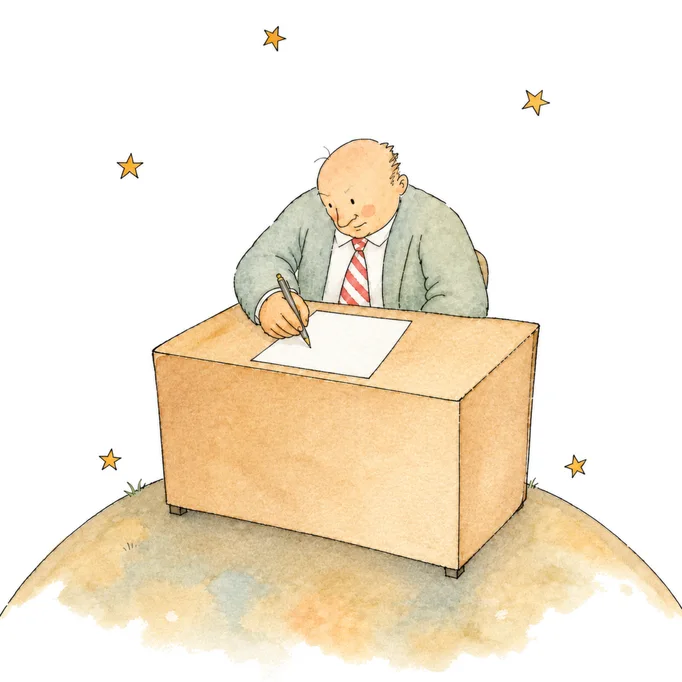
“Millions of what?”
The businessman suddenly realized that there was no hope of being left in peace until he answered this question.
“Millions of those little objects,” he said, “which one sometimes sees in the sky.”
“Flies?”
“Oh, no. Little glittering objects.”
“Bees?”
“Oh, no. Little golden objects that set lazy men to idle dreaming. As for me, I am concerned with matters of consequence. There is no time for idle dreaming in my life.”
“Ah! You mean the stars?”
“Yes, that’s it. The stars.”
“And what do you do with five-hundred millions of stars?”
“Five-hundred-and-one million, six-hundred-twenty-two thousand, seven-hundred-thirty-one. I am concerned with matters of consequence: I am accurate.”
“And what do you do with these stars?”
“What do I do with them?”
“Yes.”
“Nothing. I own them.”
“You own the stars?”
“Yes.”
“But I have already seen a king who—”
“Kings do not own, they reign over. It is a very different matter.”
“And what good does it do you to own the stars?”
“It does me the good of making me rich.”
“And what good does it do you to be rich?”
“It makes it possible for me to buy more stars, if any are discovered.”
“This man,” the little prince said to himself, “reasons a little like my poor tippler ...”
Nevertheless, he still had some more questions.
“How is it possible for one to own the stars?”
“To whom do they belong?” the businessman retorted, peevishly.
“I don’t know. To nobody.”
“Then they belong to me, because I was the first person to think of it.”
“Is that all that is necessary?”
“Certainly. When you find a diamond that belongs to nobody, it is yours. When you discover an island that belongs to nobody, it is yours. When you get an idea before any one else, you take out a patent on it: it is yours. So with me: I own the stars, because nobody else before me ever thought of owning them.”
“Yes, that is true,” said the little prince. “And what do you do with them?”
“I administer them,” replied the businessman. “I count them and recount them. It is difficult. But I am a man who is naturally interested in matters of consequence.”
The little prince was still not satisfied.
“If I owned a silk scarf,” he said, “I could put it around my neck and take it away with me.
If I owned a flower, I could pluck that flower and take it away with me. But you cannot pluck the stars from heaven ...”
“No. But I can put them in the bank.”
“Whatever does that mean?”
“That means that I write the number of my stars on a little paper. And then I put this paper in a drawer and lock it with a key.”
“And that is all?”
“That is enough,” said the businessman.
“It is entertaining,” thought the little prince. “It is rather poetic. But it is of no great consequence.”
On matters of consequence, the little prince had ideas which were very different from those of the grown-ups.
“I myself own a flower,” he continued his conversation with the businessman, “which I water every day. I own three volcanoes, which I clean out every week (for I also clean out the one that is extinct; one never knows). It is of some use to my volcanoes, and it is of some use to my flower, that I own them. But you are of no use to the stars ...”
The businessman opened his mouth, but he found nothing to say in answer. And the little prince went away.
“The grown-ups are certainly altogether extraordinary,” he said simply, talking to himself as he continued on his journey.
中文对照#
展开本章中文译文
第四颗星球属于一个商人。他忙得连小王子来了,也没有抬头。
“早上好,”小王子对他说,“你的烟灭了。”
“三加二等于五,五加七等于十二,十二加三等于十五。早上好。十五加七等于二十二,二十二加六等于二十八。我没时间重新点烟。二十六加五等于三十一。呼!这样一共就是五亿零一百六十二万二千七百三十一。”
“五亿个什么?”小王子问。
“嗯?你还在这里?五亿零一百万——我不能停……我有太多事情要做!我管的是重要的事,没工夫拿废话消遣。二加五等于七……”
“五亿零一百万个什么?”小王子又问。他这辈子只要问了一个问题,就从来不肯放过。
商人抬起头来。
“我在这颗星球上住了五十四年,只被打扰过三次。第一次是二十二年前,不知道从哪里掉下来一个金龟子,闹得惊天动地,整个星球都回响着他的声音,害得我算加法时错了四处。
第二次是十一年前,我的风湿病发作了。我缺乏锻炼,可我没有时间闲逛。第三次——就是现在!我刚才说到五亿零一百万——”
“几百万个什么?”
商人忽然明白了:不回答这个问题,就别想清静。
“几百万个小东西,”他说,“就是有时候能在天上看见的那些。”
“苍蝇?”
“不,是闪闪发光的小东西。”
“蜜蜂?”
“不,是金灿灿的小东西,会让懒人做白日梦的那种。我可不同,我管的是重要的事,一辈子都没时间做白日梦。”
“啊!你是说星星?”
“对,就是星星。”
“那你拿这五亿颗星星做什么?”
“是五亿零一百六十二万二千七百三十一颗。我管的是重要的事,数字必须精确。”
“那你拿这些星星做什么呢?”
“拿它们做什么?”
“对啊。”
“什么也不做。我拥有它们。”
“你拥有星星?”
“对。”
“可我已经见过一位国王,他——”
“国王不拥有星星,他们统治星星。这完全是两回事。”
“那拥有星星对你有什么好处?”
“能让我富有。”
“富有又有什么好处?”
“如果再发现别的星星,我就有钱买下来。”
“这个人想事情的方式,”小王子心想,“有点像那个可怜的酒鬼……”
不过,他还有几个问题要问。
“人怎么能拥有星星呢?”
“那它们属于谁?”商人不耐烦地反问。
“我不知道。不属于谁。”
“那就属于我,因为我是第一个想到这件事的人。”
“只要这样就够了?”
“当然。你发现一颗没有主人的钻石,它就是你的。你发现一座没有主人的岛,它就是你的。你比所有人都先想到一个点子,申请了专利,这个点子就属于你。我也是一样:在我之前,没人想到过要拥有星星,所以星星就是我的。”
“是,这倒没错,”小王子说,“那你拿它们做什么?”
“我管理它们,”商人回答,“我把它们数一遍,再数一遍。这很难,但我天生就对重要的事感兴趣。”
小王子仍然不满意。
“如果我有一条丝巾,”他说,“就可以把它围在脖子上,带走。如果我有一朵花,就可以摘下来,带走。可你没法把天上的星星摘下来……”
“不能。不过,我可以把它们存进银行。”
“那到底是什么意思?”
“就是把星星的数目写在一张小纸片上,再把纸片放进抽屉,用钥匙锁起来。”
“这就完了?”
“这就够了。”商人说。
“倒是挺有趣,也挺有诗意,”小王子心想,“可并不是什么重要的事。”
对于什么才算重要,小王子的想法和大人们很不一样。
他接着对商人说:“我有一朵花,每天都给她浇水。我有三座火山,每个星期都清理,连那座死火山也清理——谁知道呢。对我的花和火山来说,我拥有它们,是有用处的。可你对星星一点用处也没有……”
商人张了张嘴,却不知道该怎么回答。小王子就离开了。
小王子继续赶路,只是自言自语地说:“大人们真是古怪得不可思议。”
回到 小王子双语分章阅读30 选章,或在 小王子精读08·掌声、酒和星星6 跟读课堂选段。
对照课堂译本#
展开 Alan Wakeman 英译的第 13 章
The fourth planet was the businessman’s. He was so busy that he didn’t even look up when the little prince arrived.
‘Good morning,’ said the prince. ‘Your cigarette’s gone out.’ ‘Three and two makes five. Five and seven, twelve. Twelve and three, fifteen. Good morning. Fifteen and seven, twenty-two. Twenty-two and six, twenty-eight. No time to relight it. Twenty-six and five, thirty-one. Phew! So that makes five hundred and one million, six hundred and twenty-two thousand, seven hundred and thirty-one.’
‘Five hundred million what?’ ‘Eh? Are you still here? Five hundred and one million… erm… I forget. I’ve got so much work to do! I’m a serious man I am. I don’t idle away my life! Two and five, seven…’
‘Five hundred and one million what?’ repeated the little prince who’d never in his life given up a question once he’d asked it.
The businessman looked up. ‘I’ve only been interrupted three times in the forty-four years I’ve lived on this planet. The first time was twenty-two years ago by a beetle that arrived from somewhere or other. It made an appalling noise and I made four mistakes in my sums. The second time was eleven years ago when I had an attack of rheumatism. I don’t get enough exercise. I haven’t got time to go gallivanting about. I’m serious, I am. And the third time… well this is it! So where was I? Five hundred and one million…’
‘Million what?’ The businessman realised there was no hope of peace: ‘Those tiny things you sometimes see in the sky.’ ‘Flies?’ ‘No, no! Those tiny shiny things.’ ‘Bees?’ ‘No, no, no! Those little twinkling things that make idle people daydream. But I’m serious, I am. I haven’t got time for daydreams.’
‘Oh, stars!’
‘That’s it. Stars.’ ‘But what are you doing with five hundred million stars?’ ‘Five hundred and one million, six hundred and twenty-two thousand, seven hundred and thirty. I’m serious and precise, I am.’
‘But what are you doing with them?’ ‘What am I doing with them?’ ‘Yes.’ ‘Nothing. I own them.’ ‘Oh, so you own the stars, do you?’ `‘Yes.’ ‘But I’ve just met a king who…’ ‘Kings don’t own. They reign over. It’s quite different.’ ‘But what use is it to you to own the stars?’ ‘It makes me rich.’ ‘And what use is it to be rich?’ ‘Then I can buy more stars, if anyone finds any.’ ‘He uses the same logic as the drunkard,’ thought the little prince to himself.
`However he went on asking questions: ‘How can you own stars?’ ‘Who do you think owns them?’ snapped the businessman gruffly. ‘I don’t know. No one.’ ‘Right. So I own them because I thought of it first.’ ‘And that’s all it takes, is it?’ ‘Of course. If you find a diamond that doesn’t belong to anyone, it’s yours. If you find an island that doesn’t belong to anyone, it’s yours. If you have an idea before anyone else, you patent it, it’s yours. And I own the stars because no one’s thought of owning them before.’
‘That’s true,’ said the little prince. ‘And what are you doing with them?’ ‘I’m managing them. I’m counting and recounting them,’ said the businessman. It’s difficult, but I’m a serious man!’
The little prince still wasn’t satisfied: ‘If I owned a scarf I could wear it round my neck. If I owned a flower I could pick it and take it away. But you can’t pick the stars.’
‘No. But I can put them in the bank.’
‘What does that mean?’ ‘It means I can write how many stars I own on a piece of paper and then lock the piece of paper up in a drawer.’
‘And that’s it?’ ‘It’s enough.’ ‘It’s amusing,’ the little prince thought. ‘It’s even a little poetic. But it’s hardly serious.’
The little prince had very different ideas from grown-ups about which things are serious.
He went on: ‘I myself own a flower that I water every day. I own three volcanoes that I rake out once a week. Because I also rake out the extinct one. Just in case. It’s useful to my volcanoes and to my flower to be owned by me. But you’re no use to your stars…’
The businessman opened his mouth but couldn’t think of anything to say and the little prince left.
‘Grown-ups really are quite extraordinary,’ he thought to himself simply, during the journey.